The S-Band payload aboard the Europasat satellite is a multi-beam mobile satellite service (MSS) system operating in the 2 GHz band across the EU and UK, with operational support from Europasat.
S-Band is the 2–4 GHz segment of the microwave spectrum. Across the EU, 1980–2010 MHz for the Earth-to-space uplink and 2170–2200 MHz for the space-to-Earth downlink are set aside for mobile satellite services (MSS). In the UK, Ofcom has published a decision covering Inmarsat’s use of 1980–1995 MHz and 2170–2185 MHz.
Two operators were selected in 2009 under Commission Decision 2009/449/EC to share the band: Inmarsat and Solaris Mobile, later renamed EchoStar Mobile. Inmarsat’s assignment is 1980–1995 MHz and 2170–2185 MHz, a paired 2 × 15 MHz allocation.
The rules also allow a complementary ground component (CGC): terrestrial base stations that form an integral part of the satellite system and reuse its spectrum. The European Aviation Network uses this arrangement, pairing the satellite with an LTE ground network.
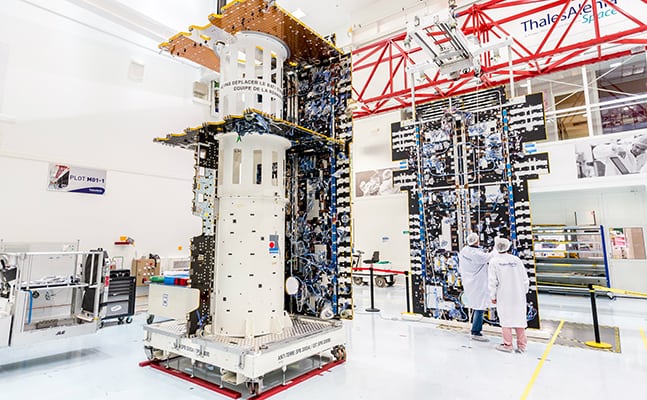
Europasat is the name given to the Inmarsat S-Band / Hellas Sat 3 satellite. It is a shared, or “condominium”, geostationary spacecraft built by Thales Alenia Space and launched in 2017, carrying an independent payload for each of two operators.
Kourou, French Guiana
Flight VA238, shared with GSAT-17
Geostationary orbit
Spacebus 4000 C4 platform
At launch
Total payload power
Multi-beam S-Band payload
1980–1995 and 2170–2185 MHz
The S-Band payload was designed for Inmarsat. It is a multi-beam payload delivering mobile satellite services across the EU and UK, and it provides the satellite link for the European Aviation Network.
The second payload serves Hellas Sat. Working in the Ku and Ka bands, it carries direct-to-home television and telecoms services across Europe, the Middle East and southern Africa.
Europasat provides operation and support for the S-Band payload and the services it enables.
The key milestones in the life of the Europasat satellite.
Thales Alenia Space designed and built the satellite on its Spacebus 4000 C4 platform.
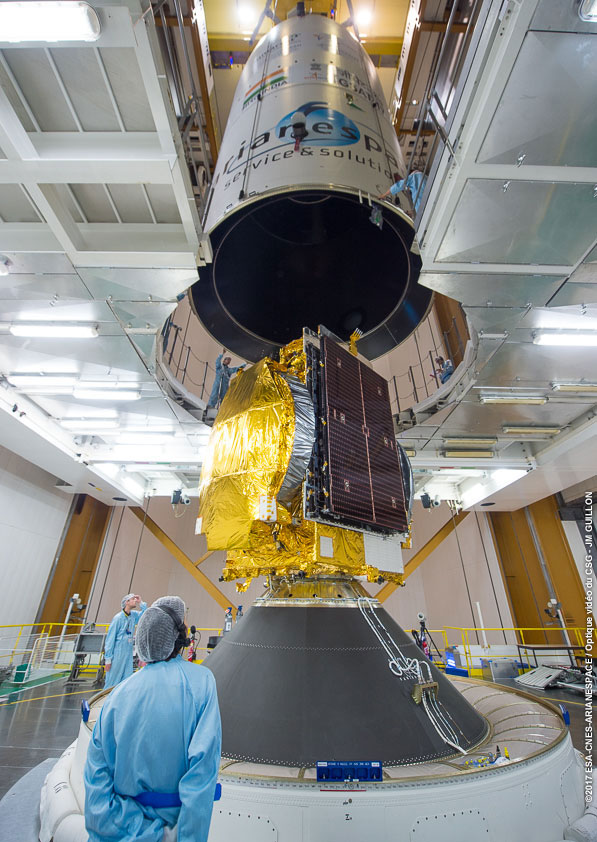
In May 2017 the finished satellite travelled to the Guiana Space Centre for its launch campaign.
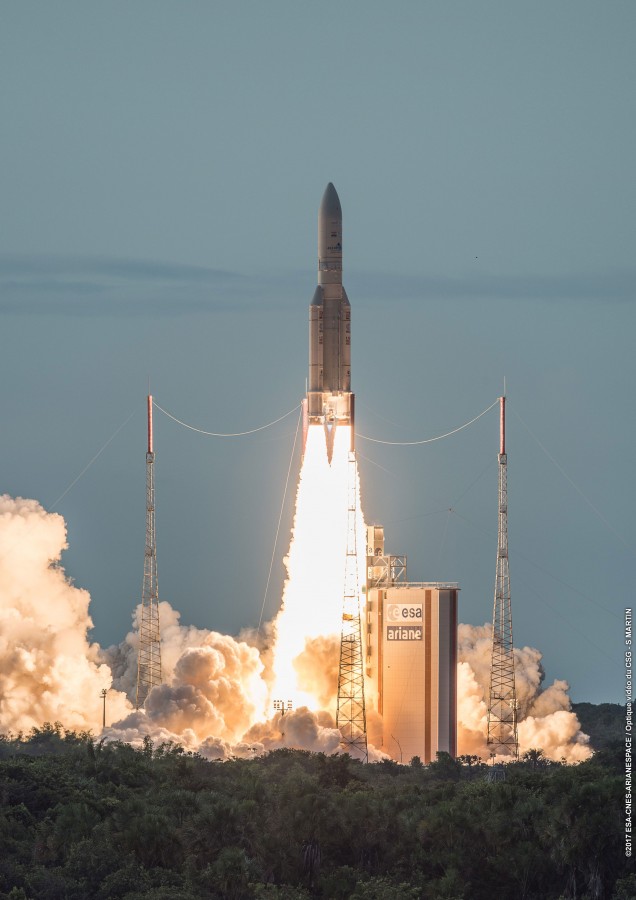
On 28 June 2017 an Ariane 5 rocket (flight VA238) carried it into space.
The satellite was positioned in geostationary orbit at 39° East.
The S-Band payload is the satellite link in the European Aviation Network, working with a Deutsche Telekom LTE ground network of around 300 sites.
Europasat provides the operational support behind the S-Band payload and its services.
S-Band signals are far less affected by rain, snow and ice than higher-frequency bands such as Ku and Ka.
A complementary ground component can reuse the same spectrum, and an onboard network communicator switches automatically between satellite and terrestrial links.
Dependable links for safety, emergency response and remote monitoring.
Viasat describes the European Aviation Network terminals as small, light and low-drag.
The best-known use is the European Aviation Network (EAN). It pairs the S-Band satellite with an LTE-based air-to-ground network of around 300 sites run by Deutsche Telekom, sharing the same 2 × 15 MHz of spectrum, and aircraft switch automatically between the two links. Viasat describes it as the world’s first integrated S-Band satellite and air-to-ground network.
Questions about the Europasat satellite or S-Band services? Get in touch and we will help.